A dealer group I worked with tried to run three rooftops on a general-purpose CRM. The BDC team liked it. The showroom managers tolerated it. The F&I office never used it, because the system had no desk, no menu, no credit application, and no way to see whether the deal funded. The group ended up running a dealership CRM and a general CRM side by side for a year, paying for both, trusting neither.
That is the thing people miss about dealership software. A car deal is not a B2B opportunity with a longer name. It moves through a specific sequence, with specific documents, specific compliance rules, and specific handoffs. A CRM built for software sales can track the customer. It cannot run the store.
Why automotive retail is a different category
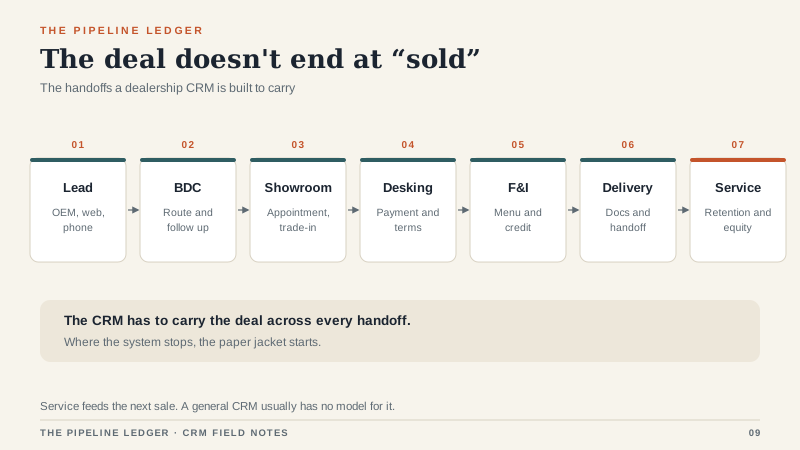
Consider what happens between a lead and a delivered vehicle. The lead arrives from an OEM, a third-party marketplace, a website form, a phone call, or a walk-in. It gets routed to a BDC rep, then to a salesperson, then to a manager. A trade-in gets appraised. A vehicle gets selected from inventory. A deal gets desked with payment options. The F&I office presents products and completes the paperwork. The vehicle gets delivered. Then service, equity mining, and the next purchase cycle begin.
Each step produces data that the next step needs. If the CRM cannot carry the deal from lead to delivery without a paper jacket, it is not a dealership CRM. It is a contact manager with a car logo.
Dealers often search for “eleads crm” when they start comparing options. The product is usually written Elead CRM, and it is one of the established names in this category. Here is what it actually covers and how to evaluate it without getting buried in a feature matrix.
What Elead CRM covers
Elead CRM is a dealership CRM owned by CDK Global. Its core strength is the deal workflow: lead management, BDC activity, showroom follow-up, desking, F&I, delivery, and service follow-up, with reporting across the store. Because it sits in the CDK ecosystem, it can connect to the dealer management system in ways a standalone CRM cannot.
That integration is the point. When the CRM knows the inventory, the deal, and the service history, a salesperson can answer questions that would otherwise require three screens and a phone call. What is the payoff on this trade? What did this customer service last year? Is there equity in the current vehicle? Those questions are the difference between a lead list and a book of business.
Pricing is quote-based, usually per rooftop and per user, with modules and support packages. Do not expect a public price list. That is normal in this category, and it means you need to compare proposals carefully rather than comparing advertised seat prices.
Where general CRMs fall short
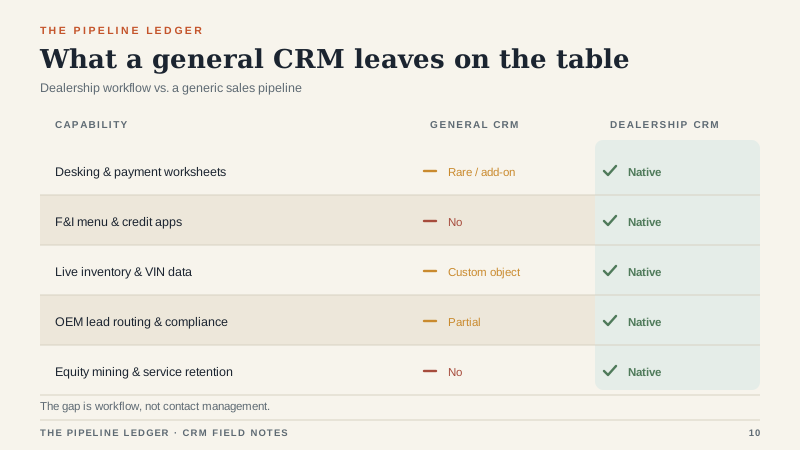
A general CRM is good at contacts, activities, pipeline stages, email, and reporting. Dealership work needs all of that plus a layer of industry-specific workflow that general vendors do not build.
Desking. A desk is a payment worksheet: vehicle price, trade, down payment, term, rate, taxes, fees, and lender options. Most general CRMs have no concept of it. If your sales managers still desk on paper or in a spreadsheet, the CRM is not running the deal.
F&I. The finance office needs a menu, product presentation, credit application, lender submission, and compliance documentation. A general CRM might store notes about the F&I conversation. It will not run the menu or prove compliance.
Inventory. A dealership CRM needs a live view of what is on the lot, including VIN, age, cost, and status. A general CRM treats inventory as a custom object at best. That means duplicate entry and stale data.
OEM and lead routing. Manufacturer leads come with their own rules, response-time requirements, and reporting. A general CRM can receive a lead. It usually cannot prove compliance with the OEM’s process.
Equity mining and service retention. The next sale often starts in the service lane. A dealership CRM can identify customers with equity, target them for trade-in, and connect the service visit to the sales opportunity. A general CRM has no native model for that.
Questions to ask before you sign
Is pricing per rooftop, per user, or both? Get the all-in number for every rooftop, including modules, training, and support. A low per-user price with three mandatory modules is not a low price.
What does the DMS integration actually do? Ask for a live walkthrough of a deal flowing from CRM to DMS and back. “Integrated” can mean a nightly file, a real-time API, or a button that opens another system.
Who owns the data, and how do we get it out? Get this in writing. You should be able to export leads, customers, activities, and deal history in a usable format.
Which OEM programs are supported? If you have franchise stores, confirm current certification and reporting support. OEM requirements change, and a gap can cost you leads.
What does implementation include? Data migration, training, BDC setup, desking templates, F&I menus, and go-live support should be itemized. Ask how many hours of training each role gets.
What is the support model? Phone, chat, email, dedicated rep, after-hours? Dealerships run evenings and weekends. Confirm coverage for the hours you actually sell.
What happens at renewal, and what is the notice period? Auto-renewal clauses are common. Calendar the notice date before you sign.
Can we see it work in a store like ours? Ask for a reference with the same franchise, similar volume, and the same DMS. A reference from a 12-rooftop group will not tell a single-point dealer much.
When Elead is overkill
Not every dealership needs a full dealership CRM. A small independent used-car lot with two salespeople, no BDC, and a simple finance relationship may do fine with a lightweight CRM and a separate desking tool. A single-point store with a strong DMS workflow may decide the marginal gain is not worth the marginal cost.
The calculation changes with rooftops, BDC headcount, F&I complexity, and OEM requirements. The more handoffs you have, the more a dealership-specific system earns its keep. The fewer handoffs, the more a general CRM can get away with, provided you accept the workflow gaps. If you are evaluating general-purpose tools, start with the CRM software buyer’s process.
The real test
Shadow one deal from lead to delivery. Watch the lead arrive, the BDC call, the appointment, the trade appraisal, the desk, the F&I menu, the delivery, and the follow-up. Count how many times someone leaves the CRM to do real work. Count how many paper forms get scanned back in. Count how many handoffs depend on a person remembering to tell someone else.
If the system can carry the deal without the paper jacket, it is a dealership CRM. If it cannot, it is a lead tracker. The logo on the login screen does not change that.
